Utilities and Grid Capacity: What the Development Supplies and What the Grid Supplies
The Sidemen Serenity development is designed to be self-sufficient for water and partially self-sufficient for electricity. This is not a compromise imposed by inadequate infrastructure it is a deliberate design decision that reduces operating costs, supports the ESG narrative, and is consistent with how all comparable premium eco-resort developments in East Bali operate.
Electricity PLN Grid
| Parameter | Data |
|---|---|
| PLN distribution infrastructure at site road frontage | Medium-voltage distribution line confirmed present |
| Connection capacity at nearest metering point (Stage 1 and 2) | Approximately 555 kVA sufficient for Stages 1 and 2 resort operations |
| Stage 3 and 4 additional connection requirement | Supplementary substation connection estimated AUD 120,000 to AUD 180,000 |
| Annual grid outage duration (pre-2020) | 60 to 90 hours of unplanned outages |
| Annual grid outage duration (2024 to 2025) | 18 to 24 hours following Bali-Java 500kV interconnector commissioning 2020 |
| Backup generation provision | 100% rated capacity diesel backup with automatic transfer switch budgeted in all scenarios |
Solar PV System
| Parameter | Specification | Financial Data |
|---|---|---|
| Recommended system size (Stage 1 and 2) | 150 to 250 kWp rooftop and carport-mounted | AUD 148,000 to AUD 265,000 installed |
| Solar resource (GHI, NASA POWER data) | 4.8 to 5.3 peak sun hours per day | Favourable for East Bali elevation |
| Estimated offset of operational consumption | 25 to 40% | Dependent on final system size and occupancy levels |
| Simple payback at current PLN tariff (B-3 commercial) | 7 to 9 years | IDR 1,650 to IDR 2,100 per kWh |
Wastewater Management
- Package wastewater treatment plant (WWTP) sized to 120 per cent of peak daily flow treating to BOD below 30 mg/L consistent with PP 82/2001 water quality standards
- Treated effluent directed to subsurface agricultural irrigation serving the retained Subak terrace areas eliminates requirement for licensed watercourse discharge point
- Estimated WWTP capital cost (80 m³/day capacity): AUD 95,000 to AUD 130,000
Solid Waste Management
- Organic waste composting system compost applied to on-site agricultural land as soil amendment
- Recyclable waste segregation and twice-weekly private contractor collection to Karangasem Regency sorting facility
- Hazardous waste (kitchen oils, cleaning chemicals, batteries) collected quarterly under licensed hazardous waste programme
- Annual operational waste management costs: AUD 12,000 to AUD 20,000 at stabilised operations for resort and eco-lodge scenarios

Spring Source Assessment
| Spring | Location | Dry-Season Flow Rate | Wet-Season Estimate | Commercial Application |
|---|---|---|---|---|
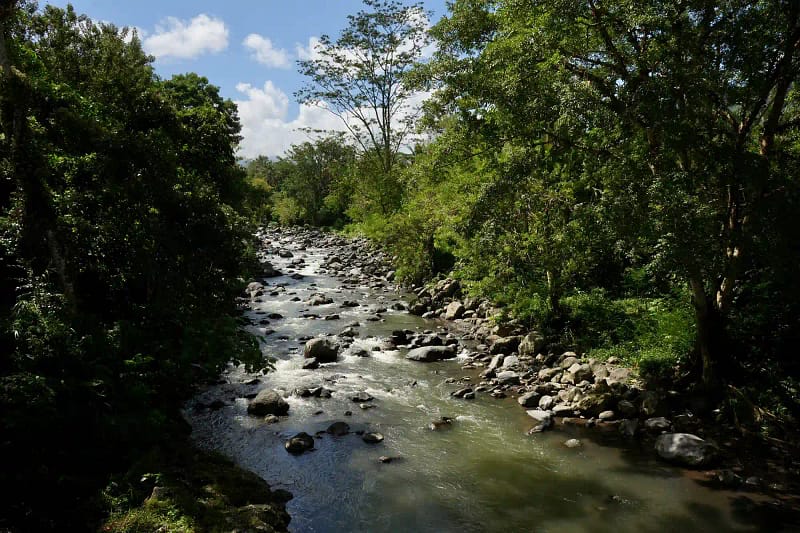
| Spring 1 | Parcel A Stage 1 boundary | 0.8 L/s (69 m³/day) | 2.4 to 4.0 L/s | Primary potable supply for resort core |
| Spring 2 | Parcel A Stage 1 boundary | 1.2 L/s (104 m³/day) | 3.6 to 6.0 L/s | Secondary supply and irrigation |
| Spring 3 | Parcel D Stage 4 conservation zone | 2.1 L/s (181 m³/day) | 6.3 to 10.5 L/s | Largest source retirement village supply |
| Combined (dry season) | Total | 4.1 L/s (354 m³/day) | 12.3 to 20.5 L/s | 2x resort operating requirement at minimum flow |
Operating Water Demand vs Supply
| Development Scenario | Estimated Daily Water Demand | Spring Supply Buffer |
|---|---|---|
| 40-key luxury resort (full operations, F&B, irrigation) | 100 to 180 m³/day | 196 to 254 m³/day surplus at dry-season minimum |
| 22-key eco-lodge | 55 to 90 m³/day | 264 to 299 m³/day surplus |
| 56-unit retirement village | 140 to 200 m³/day | 154 to 214 m³/day surplus |
| Combined resort plus retirement village | 240 to 380 m³/day | Supplementary cistern storage required in extended dry years |
Subak Water Rights Considerations
The retirement village scenario operates on a fundamentally different revenue model to the resort and eco-lodge. Rather than nightly accommodation revenue, it generates entry lease premiums at the point of occupancy commencement and ongoing monthly service charges from all occupied units. The financial dynamics are distinct and for operators familiar with the Australian retirement village sector, the model will be immediately recognisable.
The development concept is designed to respect these rights in two ways: first, by using only the surplus spring flow above the Subak’s allocation (the development does not propose to reduce water available to active rice terraces); second, by directing treated WWTP effluent to subsurface agricultural irrigation, which returns water to the soil rather than removing it from the catchment.
Access the Full Infrastructure Cost Model
Water, wastewater, solar, and grid connection costs are included in the stage-by-stage development cost breakdown in the Developer Portal feasibility pack.