Road Access and Connectivity: The Honest Assessment
Road access is Sidemen’s most frequently cited limitation by investors who have not visited. It deserves a factual assessment, not a dismissal. The current access time of 1 hour 45 minutes to 2 hours 15 minutes from the airport is a genuine consideration but it is improving, it compares favourably to alternative highland destinations, and it is manageable through thoughtful guest arrival design.
Primary Access Route Current Conditions
| Route Segment | Distance | Road Condition | Time (Typical) |
|---|---|---|---|
| Ngurah Rai Airport to Gianyar bypass | ~35 km | Dual carriageway well maintained | 35 to 50 mins (traffic dependent) |
| Gianyar to Semarapura (Klungkung) | ~25 km | Single carriageway sealed good condition | 25 to 30 mins |
| Semarapura to Sidemen township (Jalan Raya Sidemen) | ~20 km | Single carriageway resurfaced 2022, good condition | 25 to 30 mins |
| Sidemen township to estate entrance | ~4 km | Secondary sealed 4 to 4.5 m carriageway width | 8 to 12 mins |
| Total airport to estate | ~92 km | 1h 45m to 2h 15m |
The Road Improvement Programme
The Bali Provincial Government’s Regional Medium-Term Development Plan (RPJMD 2023 to 2028) designates the Klungkung to Karangasem corridor as a priority road improvement zone. The planned works include:
- Lane widening on the Semarapura to Amlapura arterial increasing from 2-lane to 4-lane carriageway in priority sections
- Gradient reduction works on the Sidemen approach roads easing the steepest bends on the Sidemen township to estate section
- Improved intersection geometry at the Duda junction the primary access decision point from the arterial highway
- Projected impact: 20 to 30 minute reduction in peak-hour airport-to-estate drive time on completion, bringing the range to 75 to 105 minutes
- Works timeline: Contracted for commencement in 2025 to 2026 fiscal year; completion targeted mid-2027

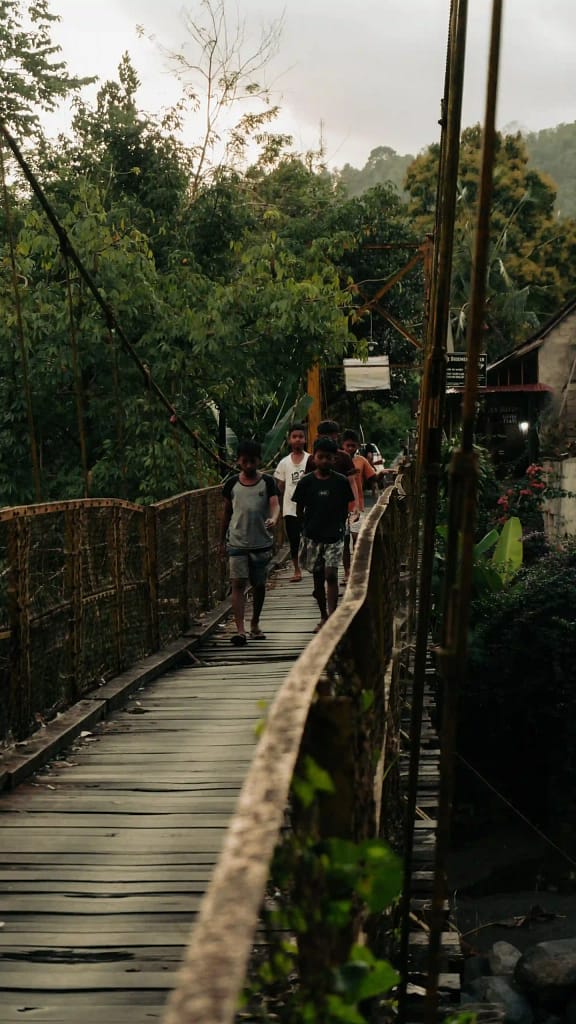
Managing the Access Experience for Guests
Premium Bali highland resorts with comparable or longer drive times including Capella Ubud (60 to 80 minutes in typical traffic) and Munduk properties (140 to 165 minutes) manage the guest arrival experience through:
- Estate vehicles collecting guests from the airport or from a designated South Bali transfer point the drive becomes part of the experience, not an inconvenience
- Minimum stay policies of 2 to 3 nights, which amortise the travel time across a longer stay and discourage the 1-night stays that make long drives feel disproportionate
- Pre-arrival itinerary content that frames the journey through Klungkung's historical sites and the rural East Bali landscape as a deliberate transition out of the South Bali pace this positioning is used by multiple comparable highland properties and is a genuine differentiator
Site Access Last 4 Kilometres
The final 4 kilometres from the Sidemen township to the estate entrance is on a secondary sealed road with an approximate carriageway width of 4 to 4.5 metres. This is sufficient for guest arrivals in standard vehicles and small minibuses but constrains full-size coach access. The development concept specifies:
- A designated transfer point near the Sidemen township for groups larger than 15 persons
- A small fleet of estate 4WD vehicles and 12-seat mini-coaches for transfer from the township to the estate
- Road widening along the most critical 600-metre section closest to the estate entrance included in the infrastructure development budget

Airport Access: Ngurah Rai International Airport and the Sidemen Corridor
| Parameter | Data |
|---|---|
| Airport name | Ngurah Rai International Airport (DPS) |
| Airport location | Tuban, Kuta, Badung southern Bali |
| Distance to Sidemen Serenity Estate | Approximately 92 kilometres |
| Current drive time (typical) | 1 hour 45 minutes to 2 hours 15 minutes |
| 2025 international passenger movements | Approximately 6.28 million |
| Airport design capacity (current) | Approximately 18 million passengers per year |
| Terminal expansion under construction (2026) | Targeting 25 million passengers per year capacity |
Direct International Routes Serving Key Source Markets 2026
| Route | Airlines | Frequency | Relevance |
|---|---|---|---|
| Sydney to Bali | Garuda Indonesia, Jetstar, Qantas | Daily multiple | Primary Australian source market |
| Melbourne to Bali | Jetstar, Scoot, Garuda | Daily multiple | Primary Australian source market |
| Perth to Bali | Jetstar, Garuda, SriLankan | Daily | Strong Western Australia connection |
| Singapore to Bali | SIA, Garuda, Lion Air, Scoot | Multiple daily | Regional short-haul premium market |
| Tokyo to Bali | Garuda, JAL, ANA | Daily | Japanese market strong wellness travel segment |
| Frankfurt/Amsterdam/Paris to Bali | KLM, Air France, Lufthansa via hub | Daily via connection | European premium market |
| London to Bali | British Airways, Emirates, Singapore Airlines via hub | Daily | UK premium and long-stay market |
Airport Expansion Context
The current terminal capacity expansion programme, underway as at 2026, will bring Ngurah Rai’s effective capacity from approximately 18 million to 25 million annual passengers. This is the enabling infrastructure for the Indonesian Government’s target of 8 million Bali international arrivals by 2028 and 10 million by 2034. The expansion also facilitates new direct routes from secondary Australian cities, Indian gateway cities, and expanded Middle Eastern connectivity via hub carriers each of which broadens the Sidemen catchment market.

See the Infrastructure Masterplan Map
The interactive masterplan map shows road access routes, transfer points, and proposed internal road network across all four development stages.